BAXRLL
Biosignal Adaptive XR for Language Learning
Introduction
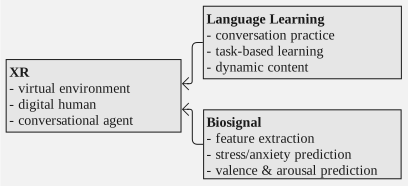
The integration of eXtended Reality (XR) in language learning has significantly enhanced engagement and improved memory retention. However, traditional XR learning environments often lack the ability to fully personalize the learning experience, as they do not account for the learner’s physiological and emotional states. We propose baxrll (Biosignal Adaptive XR for Language Learning) approach that personalizes the learning experience by monitoring and responding to the learner’s physiological indicators in real-time. By adjusting the difficulty and pedagogical approach based on stress and emotional data collected from wearable sensors, the aim is to create a more effective and personalized learning environment. The study will evaluate the impact on language learning through a comparative study, assessing key areas such as vocabulary acquisition, grammar proficiency, speaking fluency, and learner engagement.
Scientific Background
Immersive language learning presents unique challenges, particularly in replicating the dynamism and responsiveness of real-world interactions. One critical limitation is the current lack of adaptation to learners’ physiological and cognitive states. Unlike real-world scenarios where human interaction naturally adjusts to emotional cues, most XR language learning environments remain static, offering a one-size-fits-all approach regardless of the learner’s emotional state. The foundational theories underpinning this research highlight the importance of empathy and emotion regulation in social interactions. A process model of empathy for virtual agents [7] treats empathy as a dynamic process modulated by various factors. This model, grounded in psychological theories, aims to create more realistic and engaging virtual agents capable of empathic interactions. Emotional Contagion [8], and Emotional Mimicry [9], further emphasize the significance of synchronized emotional responses in fostering empathy and enhancing social bonds. Despite these insights, a significant gap exists in applying such models to language learning in XR environments. Recent studies [10, 11] have begun to explore the potential of biosignal-driven adaptations in XR. These studies suggest that integrating physiological data can significantly improve user experience and interaction quality. However, applying these findings to language learning, particularly in adapting virtual environments based on biosignals, still needs to be explored. baxrll seeks to address this gap by investigating how XR environments can be tailored to language learners’ physiological and cognitive states. By incorporating models of empathy and emotion regulation, the study aims to create more adaptive and responsive learning environments that enhance language acquisition and improve the overall learning experience.
Significance
baxrll aims to bridge the gap in language learning by leveraging XR technology to create personalized and adaptive learning environments, contributing directly to the SDG-4 (Quality Education) by enhancing language acquisition and reducing educational inequalities, particularly in Japan where language learners often struggle with speaking skills despite proficiency in reading and writing
References
- [1]M. Muklas, R. Yuliana, E. Nurkhasanah, L. N. Fahriza, and S. Z. Yulianda, "Analysis of the factors affecting students' English speaking proficiency," Wiralodra English J., vol. 8, pp. 154–164, 2024.
- [2]H. Kimura, Investigating Second Language Pronunciation Anxiety in the Japanese Context. Springer Science and Business Media Deutschland GmbH, 2021, pp. 73–93.
- [3]A. Muroya, "Interpreting unwillingness to speak l2 english by japanese efl learners," Open Linguistics, vol. 9, 1 2023.
- [4]N. Dover, "Pronunciation needs analysis of Japanese students," Int. J. of Social Science and Human Research, vol. 05, 2022.
- [5]S. Pasfield-Neofitou, H. Huang, and S. Grant, "Lost in second life: virtual embodiment and language learning via multimodal communication," Educational Technology Research and Development, vol. 63, pp. 709–726, 2015.
- [6]A. Albraikan, B. Hafidh, and A. E. Saddik, "Iaware: A real-time emotional biofeedback system based on physiological signals," IEEE Access, vol. 6, pp. 78 780–78 789, 2018.
- [7]S. H. Rodrigues, S. Mascarenhas, J. Dias, and A. Paiva, "A process model of empathy for virtual agents," Interacting with Computers, vol. 27, no. 4, pp. 371–391, 2015.
- [8]E. Hatfield, J. T. Cacioppo, and R. L. Rapson, "Emotional contagion," Current directions in psychological science, vol. 2, no. 3, pp. 96–100, 1993.
- [9]U. Hess and A. Fischer, "Emotional mimicry: Why and when we mimic emotions," Social and Personality Psychology Compass, vol. 8, pp. 45–57, 2014.
- [10]K. Gupta, Y. Zhang, T. S. Gunasekaran, N. Krishna, Y. S. Pai, and M. Billinghurst, "Caevr: Biosignals-driven context-aware empathy in virtual reality," IEEE Trans. on Visualization and Computer Graphics, vol. 30, pp. 2671–2681, 2024.
- [11]P. Sasikumar, R. Hajika, K. Gupta, T. S. Gunasekaran, Y. S. Pai, H. Bai, S. Nanayakkara, and M. Billinghurst, "A user study on sharing physiological cues in vr assembly tasks," in IEEE VR. Institute of Electrical and Electronics Engineers Inc., 2024, pp. 765–773.
- [12]P. Peterson, S. Showalter, and T. S. Macarro, "Stem strategies for english language learners (ell) with disabilities," International Institute of Informatics and Systemics, IIIS, 2014.
Team
University of Aizu, Associate Professor
University of Aizu, Senior Associate Professor
University of Aizu, Professor
Publications
- Nassani, A., Blake, J., & Villegas, J. (2025). Adaptive learning companions: Enhancing education with biosignal-driven digital human. In Proceedings of the Extended Abstracts of the CHI Conference on Human Factors in Computing Systems (pp. 1-7).